“Probability Universe” Introductory Series · Issue 03
Why Do Some People Always Have “Good Luck”?
You’ve surely seen people like this:
They always seem to hit the right timing. Starting a business when the trend emerges, investing at the bottom, job-hopping to great companies. You say they’re lucky, but their “good luck” seems to follow some pattern—not once or twice, but continuously, systematically “lucky.”
Conversely, you’ve also seen another type:
They work hard, they’re smart, but they’re always just a bit off. Starting a business half a year too late, investing at the peak, job-hopping to companies about to decline. You say they’re unlucky, but their “bad luck” also seems to follow some pattern—not once or twice, but continuously, systematically “unlucky.”
This isn’t mysticism. This is structure.
The “Highways” in the Probability Cloud
Last issue we said life is a probability cloud, not a line.
But the probability cloud isn’t uniform. It has varying densities, highs and lows.
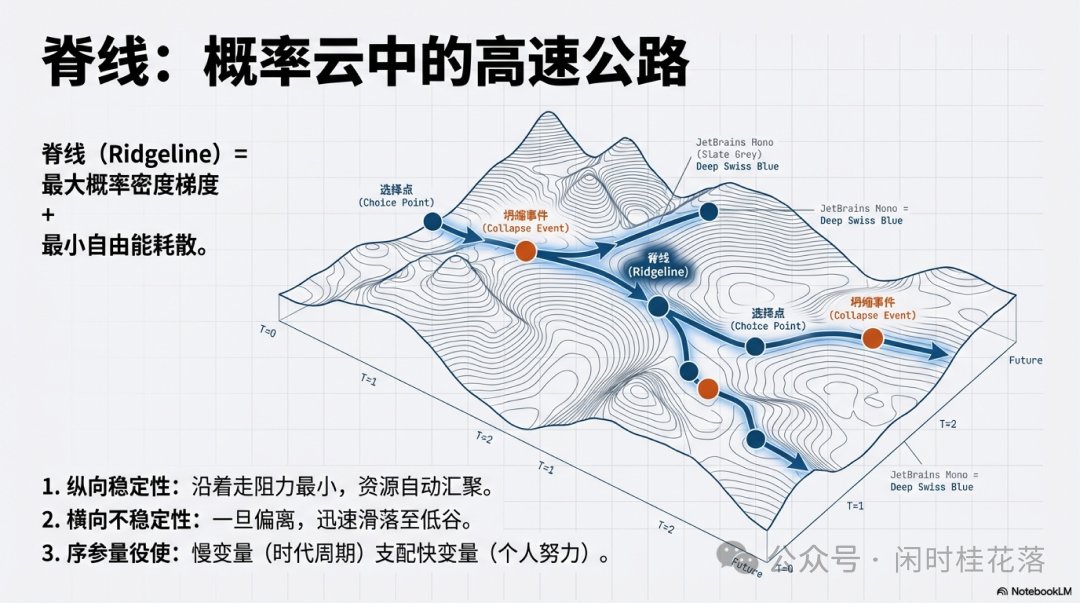
Imagine: If you drew the probability cloud as a 3D terrain map, high probability density areas are ridges, low probability density areas are valleys.
On this terrain map, certain special paths exist:
- Walking along these paths offers minimum resistance
- Probability density naturally concentrates toward these paths
- Once on these paths, it’s hard to fall off
- But if you deviate from these paths, you’ll rapidly slide down
These paths are “ridgelines.”
The Precise Definition of Ridgelines
In more precise language:
Ridgeline = In the high-dimensional probability manifold, spontaneously formed through long-term evolution: geodesic flow tubes connecting major attractor basins with “maximum probability density gradient + minimum free energy dissipation + maximum structural stability.”
Too abstract? Another way to put it:
Ridgeline = The path in the probability cloud that, over time scales, is most easily written as “fate.”
Or more directly:
Ridgeline = The highway of fate.
Three Properties of Ridgelines
- Longitudinal Stability: Walking Along the Ridgeline Offers Minimum Resistance
On the ridgeline, you’ll feel “smooth.”
Not that there are no difficulties, but difficulties are “solvable.” The problems you encounter have been encountered before, have solutions, have resources available.
This is why some people “get smoother as they go”—they’re on the ridgeline.
- Lateral Instability: Deviating from the Ridgeline Leads to Rapid Descent
The sides of the ridgeline are cliffs.
Once you deviate from the ridgeline, you’ll feel “nothing works no matter how hard I try.” Problems multiply as you solve them, resources deplete as you use them, opportunities grow more distant.
This is why some people “get worse the harder they try”—they’ve deviated from the ridgeline, struggling in the valley.
- Reflexive Curvature: Strong Agents Can Bend the Ridgeline
Ridgelines aren’t completely objective.
When a sufficiently strong agent (individual, company, nation) firmly walks a certain path, their very existence increases that path’s probability density, attracts more resources, and turns that path into a ridgeline.
This is the physics explanation for “heroes create the times.”
How to Identify Ridgelines?
This is the most practical question. Here are three core criteria:
Criterion One: Probability Concentration
Ask: Do excellent people naturally gather here?
True ridgeline characteristics:
- High density of talented people
- Many second chances (can try again after failure)
- High survivor ratio
False ridgeline characteristics:
- Only a few “stars,” most people obscure
- One failure and you’re out
- Extremely low survivor ratio
Criterion Two: Structural Stability
Ask: Is there strong dependence on a single system/technology/relationship?
True ridgeline characteristics:
- Not afraid of cycles
- Not afraid of policy changes
- Not afraid of technological substitution
False ridgeline characteristics:
- Depends on a specific policy
- Depends on a specific technology
- Depends on a specific relationship
Criterion Three: Time Extensibility
Ask: Will this path still exist in 30 years?
True ridgeline characteristics:
- Aligned with civilization’s long-term main evolutionary direction
- Solves “eternal problems” (health, education, communication, transactions…)
- Form may change, essence won’t
False ridgeline characteristics:
- Depends on short-term trends
- Solves “temporary problems”
- Disappears when the trend passes
A Key Insight
Ridgelines are extremely few in number.
In any field, true ridgelines may number only 2-3. Other things that look like “opportunities” are mostly small mounds in the valley—exhausting to climb, and after climbing you find you’re still at the bottom.
This is why “choice matters more than effort.”
Not that effort doesn’t matter, but: Effort on the ridgeline versus effort in the valley differs by orders of magnitude in effect.
Why Are Ridgelines So Few?
This involves a physics concept: The Order Parameter Slaving Principle.
Simply put: In any complex system, two types of variables exist:
- Fast variables: Noise, short-term emotions, random fluctuations—decay quickly, cancel each other out
- Slow variables: Population cycles, technological paradigms, cultural genes—decay slowly, dominate evolution
Ridgelines are essentially trajectories dominated by a few “slow variables.” They “enslave” all other fast variables.
Fate Engineering Corollary:
Finding ridgelines is essentially the process of “eliminating fast variables, locking onto slow variables.“If you stare at stock price fluctuations (fast variables) every day, you won’t see the ridgeline of industrial cycles (slow variables).
Summary
- Ridgelines are the “highways” in the probability cloud, the paths where fate is most easily written
- Ridgelines have three properties: longitudinal stability, lateral instability, reflexive curvature
- Three criteria for identifying ridgelines: probability concentration, structural stability, time extensibility
- Ridgelines are extremely few, dominated by “slow variables”
- Effort on the ridgeline versus effort in the valley differs by orders of magnitude
Boundary Statement
Ridgelines are a thinking tool, not a prediction tool.
They can help you:
- Evaluate whether a direction is worth investing in
- Understand why some efforts feel “off”
- Make better judgments among multiple choices
They cannot help you:
- Precisely predict which path will definitely succeed
- Guarantee you’ll find the ridgeline
- Replace your own judgment and action
Remember: Ridgelines are probability advantages, not certainty guarantees.
Next Issue Preview: Life’s True Choice Moments Number Only 3-7—Bifurcation Points
This article is based on the SPUD theoretical framework (Structure-Probability Unified Dynamics) Series articles continuously updated
原文:https://x.com/unicome163/status/2021120594427904282