“Probability Universe” Introductory Series · Issue 04
A Counterintuitive Fact
We make choices every day.
What to eat for breakfast, what clothes to wear, which route to take to work, which email to reply to… By the end of the day, you might have made hundreds of “choices.”
But if you look back on your life, how many choices truly changed your fate’s trajectory?
Most people will find: The truly important choices can be counted on one hand.
College major selection, first job, marriage partner, whether to start a business, whether to emigrate…
This isn’t coincidence. This is the structure of fate.
Bifurcation Points: Where Ridgelines Fork
Last issue we discussed ridgelines—the highways of fate.
But ridgelines aren’t straight lines. They fork.
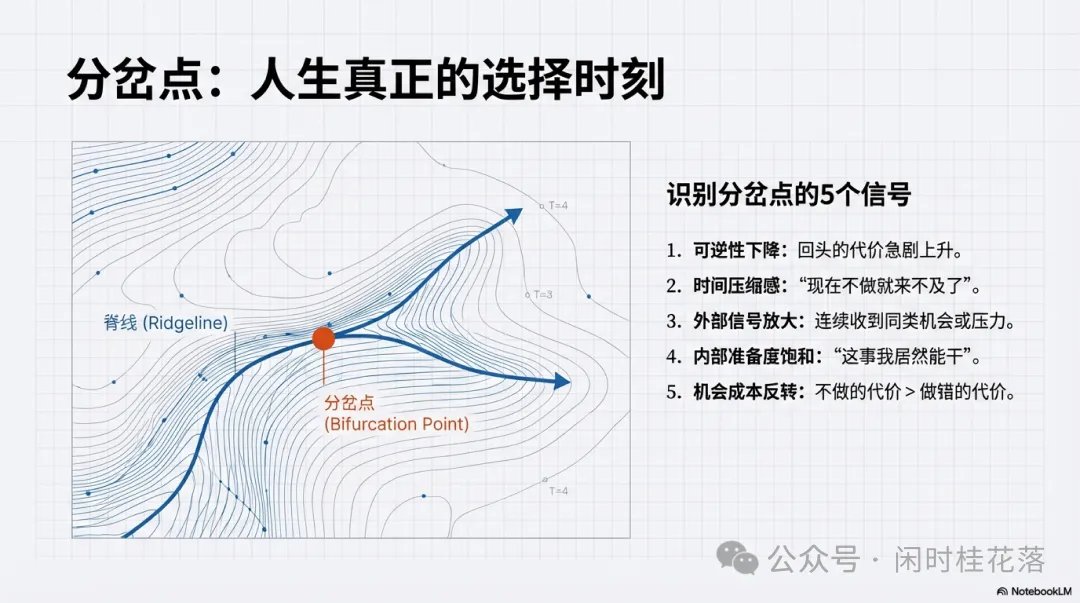
Imagine walking along a mountain ridge. Most of the time, there’s only one path; you just need to keep walking forward. But occasionally, you encounter a fork: the ridge splits into two, one going left, one going right.
This fork is a “bifurcation point.”
Before the bifurcation point, your choices don’t matter much—you’re on the same ridgeline anyway. After the bifurcation point, your choices also don’t matter much—you’re already on a certain ridgeline. Only at the bifurcation point do your choices truly determine fate.
Why Are Bifurcation Points So Few?
Because ridgelines themselves are few.
Ridgelines are stable trajectories dominated by “slow variables.” Slow variables don’t change frequently, so ridgelines don’t fork frequently either.
In a person’s lifetime, they may encounter only 3-7 true bifurcation points.
The rest of the time, you think you’re “making choices,” but you’re actually just fine-tuning on the ridgeline—drifting a bit left, drifting a bit right, but always on the same ridgeline.
How to Identify Bifurcation Points?
Bifurcation points have several typical characteristics:
Characteristic One: Reversibility Drops Sharply
Before the bifurcation point, you can “think about it more,” “try it first,” “come back if it doesn’t work.” After the bifurcation point, the cost of turning back rises sharply, or turning back becomes impossible.
Examples:
- Signed employment contract vs. still interviewing
- Got marriage certificate vs. still dating
- Quit job to start business vs. still observing
Characteristic Two: External Signals Amplify
As the bifurcation point approaches, you’ll receive dense “signals”—opportunities, invitations, pressure, urging.
These signals may come from:
- External environment (industry changes, policy adjustments)
- Social relationships (friend invitations, family urging)
- Internal state (anxiety, excitement, the feeling of “if I don’t do it now, it’ll be too late”)
Characteristic Three: Opportunity Cost Reversal
At the bifurcation point, the cost of “not doing” begins to exceed the cost of “doing wrong.”
Before, you could say “wait a bit longer,” but now “waiting a bit longer” itself is a choice—and possibly a worse one.
Characteristic Four: Internal Readiness Saturation
You’ll have a feeling: “I can actually do this.”
Not blind confidence, but a sense of “being ready.” Skills, resources, mindset—all have reached a certain threshold.
Characteristic Five: Time Compression Sensation
“If I don’t do it now, it’ll be too late.”
This feeling might be real, or it might be an illusion. But its appearance itself is a signal of a bifurcation point.
Five Necessary Conditions for Bifurcation Points
When three or more of the following conditions are simultaneously true, you may be standing at a bifurcation point:
- ✅ Reversibility declining (last window to turn back)
- ✅ External signals amplifying (receiving similar opportunities consecutively)
- ✅ Internal readiness saturated (“I can actually do this”)
- ✅ Opportunity cost reversing (cost of not doing > cost of doing wrong)
- ✅ Time compression sensation (“If I don’t do it now, it’ll be too late”)
What to Do at a Bifurcation Point?
- First, Confirm Whether This Is a Real Bifurcation Point
Much “urgency” is manufactured. Salespeople are pushing you, friends are persuading you, society is making you anxious.
Test with the five conditions above: Is this a real bifurcation point, or false urgency?
- If It’s a Real Bifurcation Point, Don’t Delay
The window period for bifurcation points is limited. Miss it, and either the opportunity disappears, or you’re passively pushed toward some ridgeline.
“Not choosing” is itself a choice—and usually a worse one.
- Choose the “Higher-Level” Ridgeline
Not all ridgelines are equal. Some ridgelines lead to broader possibilities; some lead to dead ends.
Evaluate using last issue’s three criteria: probability concentration, structural stability, time extensibility.
- Accept Uncertainty
At a bifurcation point, you cannot have “perfect information.” If you wait until you’re “completely certain” to make a choice, you’ve already missed the bifurcation point.
The essence of a bifurcation point is making a commitment amid uncertainty.
An Important Psychological Preparation
Making choices at bifurcation points usually doesn’t feel “exciting,” but “heavy.”
Because you know: This choice will close many possibilities. You chose A, and you’ll never know how B would have turned out.
This feeling is normal. It shows you’re taking this choice seriously.
But don’t let this heaviness stop you from making a choice.
Not choosing isn’t “preserving possibilities”—it’s “being passively pushed toward some ridgeline”—usually the worse one.
Summary
- Life’s true choice moments number only 3-7, called “bifurcation points”
- Bifurcation points are where ridgelines fork; here your choices truly determine fate
- Five characteristics for identifying bifurcation points: declining reversibility, amplifying external signals, saturated internal readiness, reversing opportunity cost, time compression sensation
- At bifurcation points: confirm authenticity, don’t delay, choose higher-level ridgelines, accept uncertainty
- The rest of the time, go with the flow
Boundary Statement
“3-7 bifurcation points” is an empirical estimate, not a precise number.
Some people may have more, some may have fewer. The key isn’t the number itself, but this insight:
Most of the time, your choices don’t matter much. But at a few key moments, your choices determine everything.
Identifying these key moments is more important than agonizing over daily trivialities.
Next Issue Preview: The Gravity Well of Fate—Attractors
This article is based on the SPUD theoretical framework (Structure-Probability Unified Dynamics) Series articles continuously updated
原文:https://x.com/unicome163/status/2021121307430318449